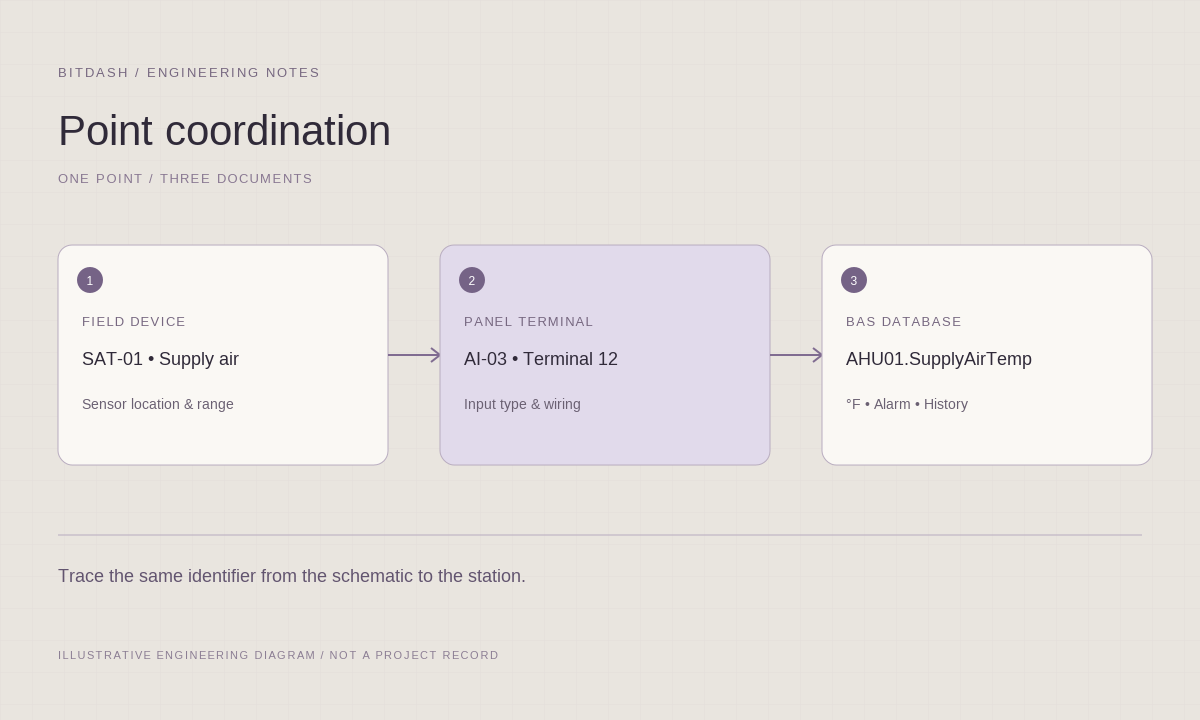
A point should be traceable from the equipment schematic to its panel connection, software reference and verification record.
Begin with the design boundary
Start with the mechanical equipment schedule, specifications, approved design intent and owner standards. Record which systems are included and which interfaces are supplied by others. An AHU package may involve the unit manufacturer, the controls contractor, electrical power, an IT network and the commissioning team. A drawing can be visually complete while leaving one of those responsibilities unresolved.
Bitdash’s engineering scope connects these inputs through equipment schematics, point schedules, panel details and review comments. The initial review should identify missing information before it becomes an installation assumption.
Coordinate the same point across every document
Use a stable equipment identifier and point name. For an analog input, identify the measurement, input signal, engineering units, expected range and controller channel. For an output, distinguish the command from the feedback used to confirm physical response. Include network points and calculated values in the database plan without treating them as spare physical I/O.
For example, a supply-air-temperature input needs a sensor location, panel reference, signal type and display unit. If the operator interface uses °F, the sensor scaling, controller value, alarm limits and displayed history must describe the same measurement. Changing a suffix alone does not convert a value.
Make interfaces reviewable
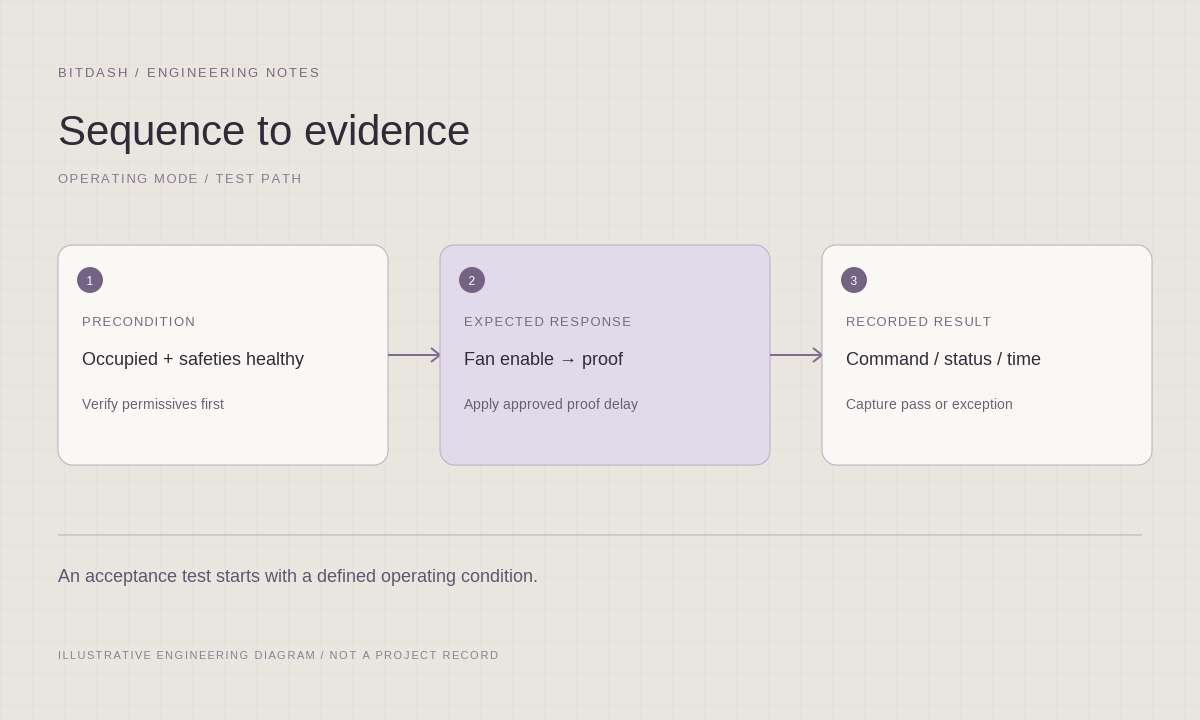
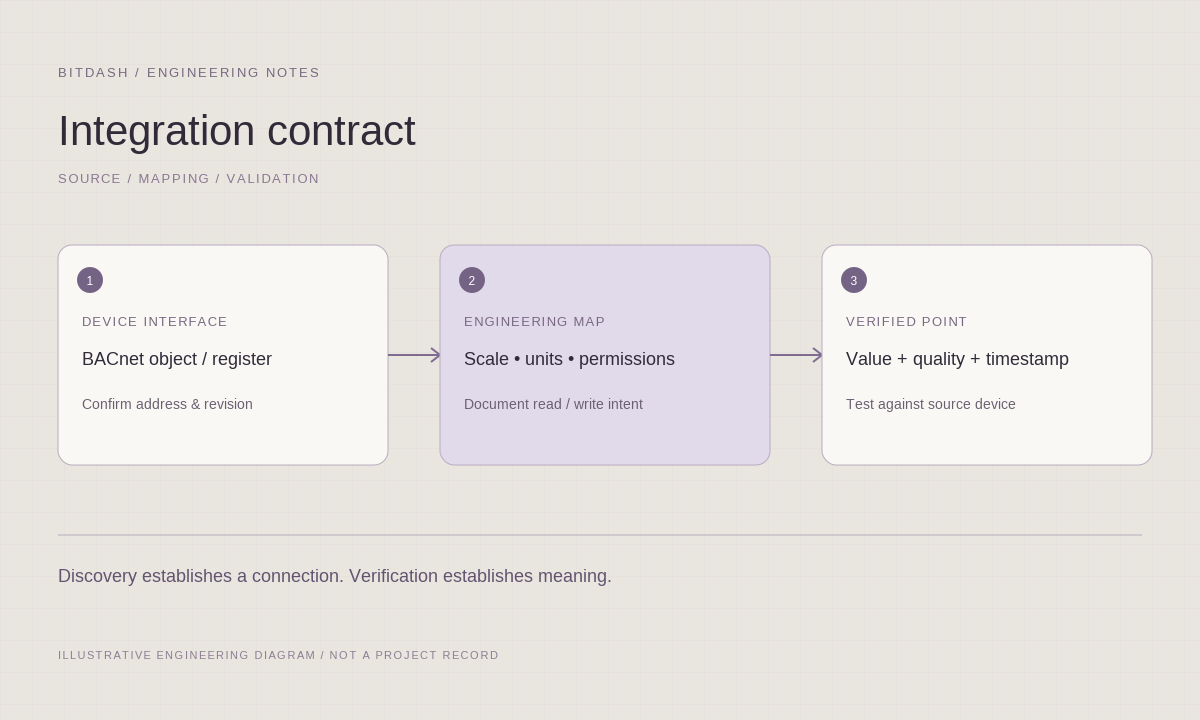
A packaged unit may expose a network interface, hardwired contacts or both. Document the approved point map, command permissions, communication-loss behavior and the party responsible for verification. A proof contact and a software command are different pieces of evidence; keep both visible where the design requires them.
Treat controller capacity, transformer loading, network architecture and device selections as coordinated engineering checks. Raise unclear requirements through the project’s technical review process and record the accepted resolution.
Close the revision loop
Issue a package with a revision identifier, outstanding questions and a clear review owner. Carry agreed changes into the drawing set and schedules together. After installation, verified field markups can become the basis for record updates.
A useful handover package shows the final agreed configuration and any remaining exceptions. It should make the next maintenance or expansion task easier to understand, even when a different engineer opens the documents.
| Document | What to coordinate | Useful review evidence |
|---|---|---|
| Equipment schematic | Device location, signal and control relationship | Cross-reference to point schedule |
| I/O schedule | Type, units, range and controller channel | Channel allocation and naming review |
| Panel / wiring detail | Power, terminals and field connections | Selected-hardware coordination |
| Interface register | Supplier, map, permissions and behavior | Approved map and assigned test owner |
A practical review checklist
- Equipment names agree across the drawings and database.
- Commands, statuses and physical proof are identified separately.
- Assumptions and review comments have an owner and revision reference.
This guide describes an engineering approach. Final design values, testing responsibilities and deliverables follow the approved project scope.