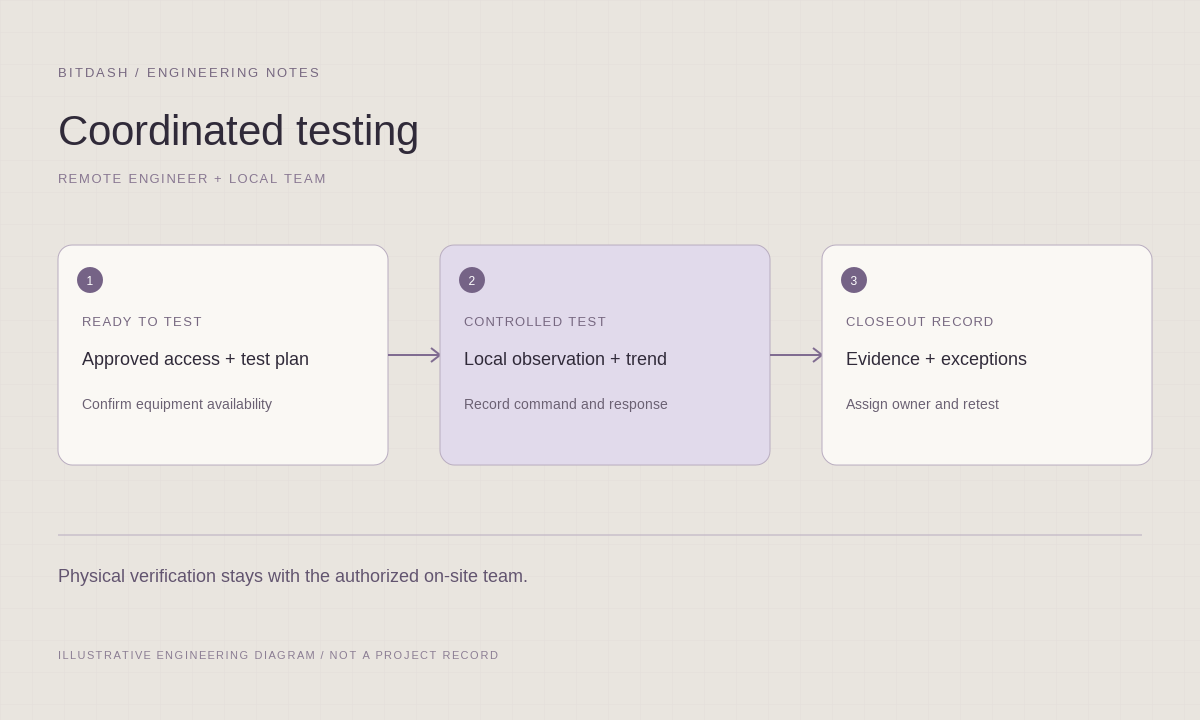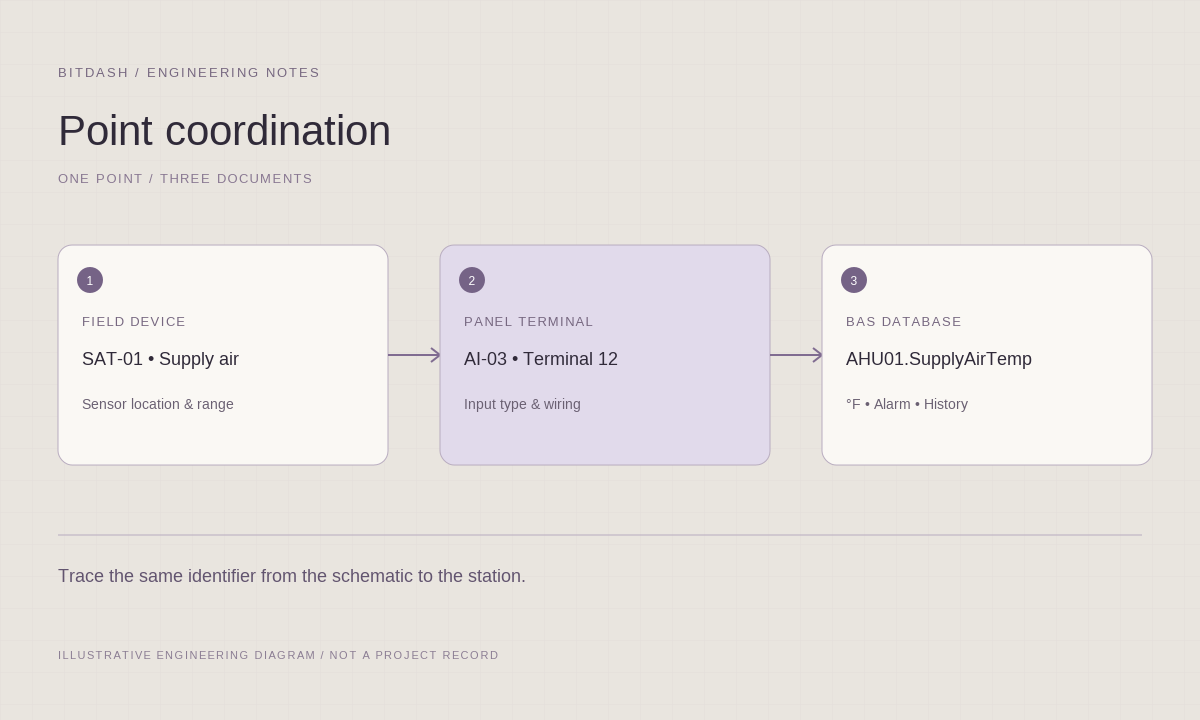
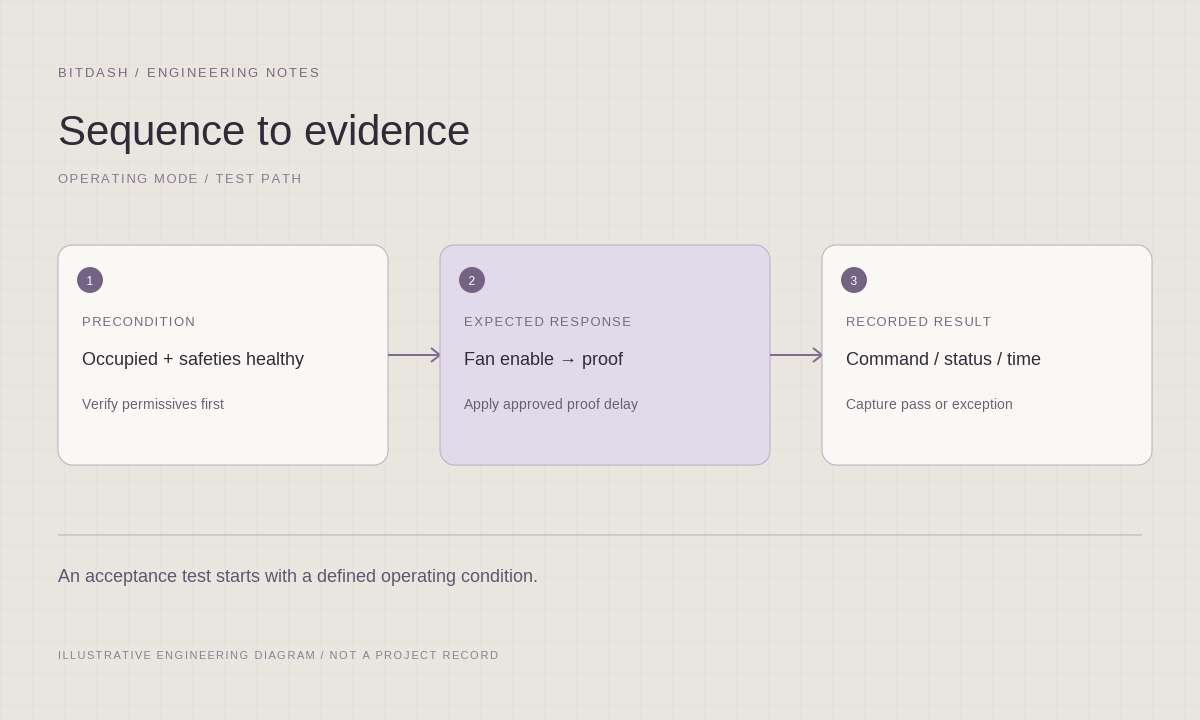
A testable sequence states the starting condition, trigger, expected response and observable evidence.
Write behavior before component logic
Describe how equipment should operate before deciding how it will be represented in a particular programming tool. Define occupied, unoccupied, startup and other project-specific modes. For each mode, explain the entry condition, exit condition and priority when requests overlap.
The narrative should identify which decisions belong in the field controller and which belong in supervision. That distinction matters when communications are unavailable or a supervisory service restarts. The approved project design determines the required behavior.
Separate settings from assumptions
List adjustable setpoints, delays, deadbands and limits using consistent names and units. Identify who approves changes and which settings are constrained by equipment requirements. A simple demonstration might use a 72°F space setpoint, but that is an illustrative value—not a universal building requirement.
State how resets are calculated, what limits apply and what happens when the required input is unavailable. Avoid phrases such as “adjust as required” without describing the intended result and the review responsibility.
Describe exceptions and recovery
Normal operation is only part of the sequence. Define the response to loss of proof, unavailable measurements, equipment faults and communication failures where relevant to the scope. Identify approved safety interfaces and any action that requires local verification.
Recovery deserves its own description: whether equipment restarts automatically, whether a delay applies, whether an operator action is required and what indicates that normal operation has returned. These conditions should remain consistent across the narrative, alarms and software.
Build the test alongside the narrative
For each operating requirement, identify a condition the test team can establish and a response it can observe. Record the approved sequence revision, test method, expected result and evidence. Trend data, controller status and field observations may all contribute.
Bitdash can align sequences, programming reviews and functional test scripts as one engineering scope. When a test exposes an ambiguity, resolve the design question and update the controlled reference before treating the software change as final.
| Requirement | Test question | Evidence |
|---|---|---|
| Occupied enable | Were the specified permissives satisfied? | Mode, schedule and permissive status |
| Fan proof | Did the expected proof follow the command? | Command trend and local verification |
| Temperature control | Did the agreed response follow a changed condition? | °F trend, setpoint and output |
| Fault recovery | Did the specified reset / restart occur? | Fault, reset and operating-state record |
A practical review checklist
- Mode priorities and transitions are explicit.
- Temperature values and differences are consistently labeled in °F.
- Each acceptance check points to an approved requirement.
This guide describes an engineering approach. Final design values, testing responsibilities and deliverables follow the approved project scope.